
Quick takeaway
- Shared chargers can cost the association nothing. With a turnkey partner like Poweral, incentives and the partner’s investment typically cover installation, and drivers pay to charge.
- Whether the board can say no depends on your state. New Jersey law bars associations from prohibiting or unreasonably restricting a charger in an owner’s designated space. Pennsylvania, Delaware and Rhode Island have no such law today.
- There are two paths. Shared chargers in common parking, decided once by the board, or individual chargers in owners’ own spaces, handled one request at a time.
- Level 2 chargers fit condos. They add about 25 miles of range per hour, enough for residents who park overnight.
- The board makes two decisions. Checking your rules, and voting on a proposal. Assessment, permits, rebates, installation and support can be handled for you.
Ready to see what your community qualifies for? Check your community’s eligibility
Sooner or later, an owner asks the board for an EV charger. The board then has to answer three questions at once: are we allowed to say no, who pays, and how do we decide fairly for everyone? This guide answers all three, with the actual law in the states where Poweral works most.
If you manage apartments rather than a condo association, start with our complete guide to EV charging for multifamily properties.
Can a condo association or HOA say no to EV chargers?
It depends on your state, and on whether the charger is for one owner’s space or for shared parking.
New Jersey: a law protects owners’ requests
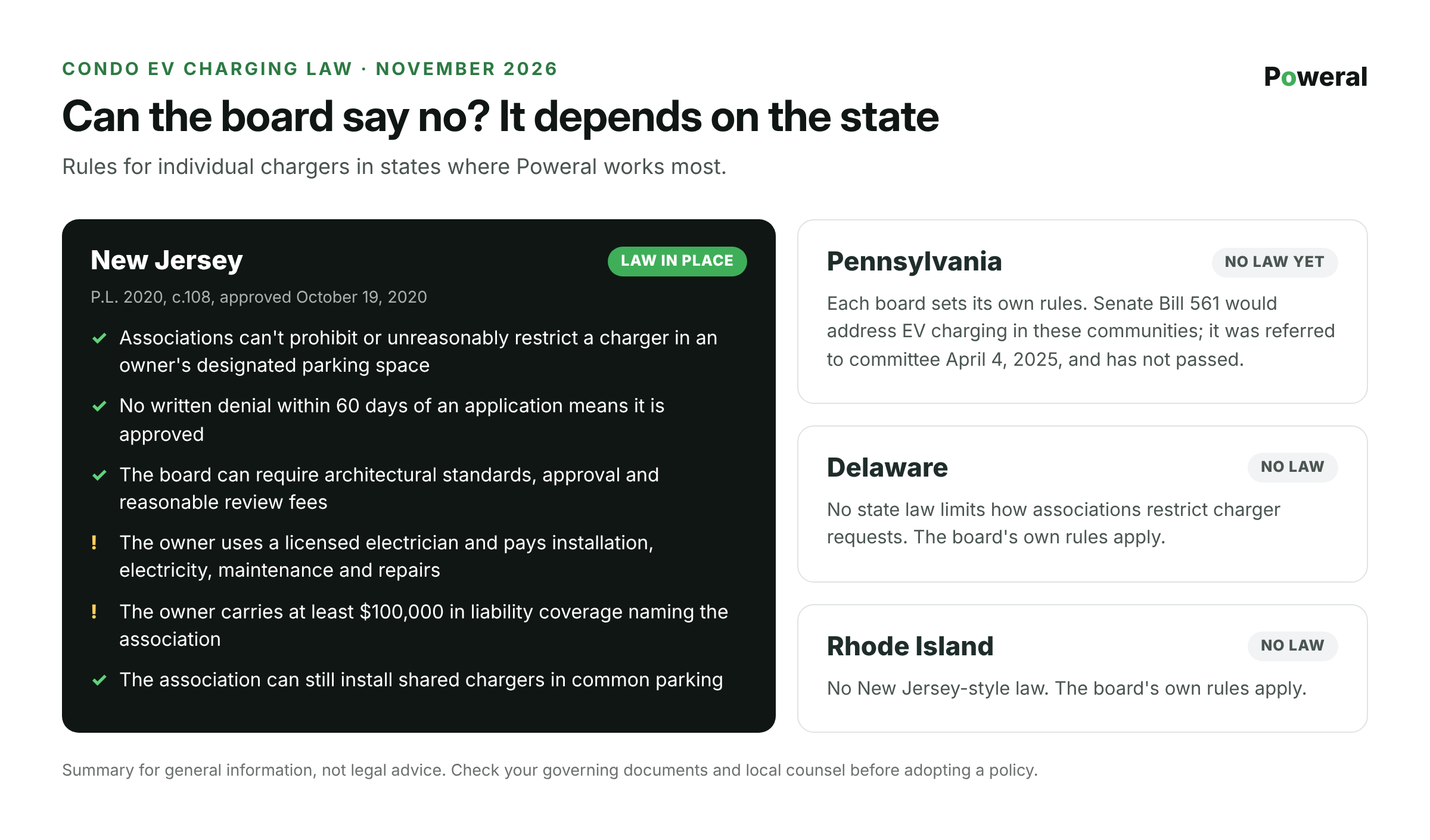
New Jersey’s law, P.L. 2020, c.108, approved October 19, 2020, says an association cannot prohibit or unreasonably restrict an EV charger in an owner’s designated parking space. A restriction counts as unreasonable if it significantly raises the charger’s cost or significantly lowers its performance. If the association doesn’t deny an application in writing within 60 days, it is approved. Read more on our New Jersey page.
The law also protects the association. The board can:
- Require the owner to follow architectural standards and get approval
- Deny an application it reasonably concludes is a life-safety risk
- Charge reasonable review fees, including engineering and legal fees
- Require the owner to use a licensed electrician
- Require the owner to pay for installation, electricity, maintenance, repairs and any damage
- Require the owner to carry at least $100,000 in liability coverage naming the association
- Install shared chargers in common parking for all owners and set rules for them
Pennsylvania: no law yet
Pennsylvania has no law limiting how condos, co-ops or planned communities restrict charger requests, so each board sets its own rules. Senate Bill 561 would address EV charging in these communities. It was referred to the Senate Transportation Committee on April 4, 2025, and has not passed. See our Pennsylvania page.
Delaware and Rhode Island: no law
Neither state has a law like New Jersey’s. The board’s own rules and governing documents decide. See our Delaware and Rhode Island pages.
This is general information, not legal advice. Check your governing documents and local counsel before adopting a policy.
Shared chargers or individual chargers: the board’s two paths
Shared chargers in common parking
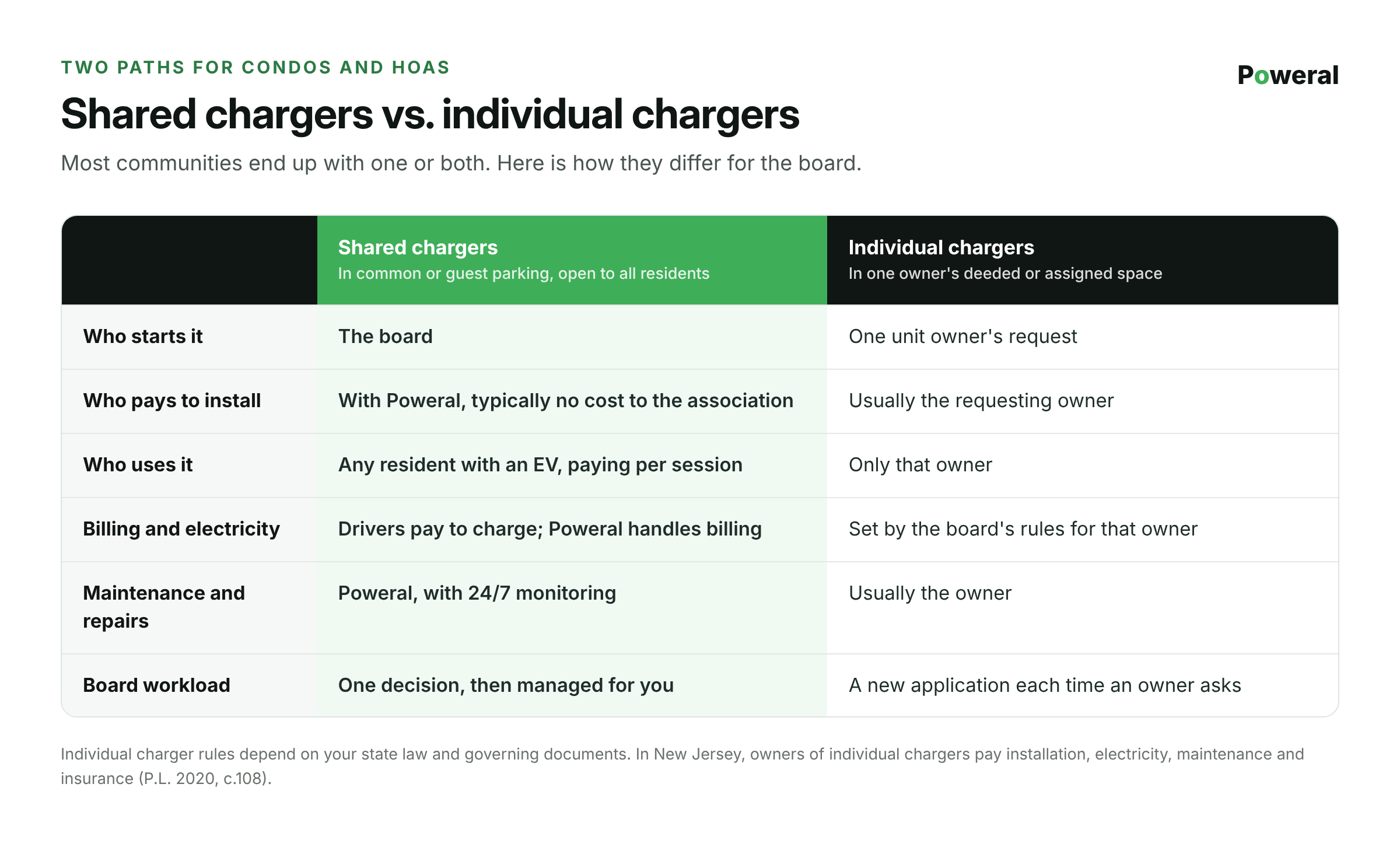
The board installs chargers in common or guest parking, open to any resident with an EV. With Poweral, installation is typically free to the association, drivers pay per session, and Poweral handles billing, maintenance and support. The board makes one decision instead of handling requests one at a time.
Individual chargers in owners’ spaces
An owner installs a charger in their own deeded or assigned space. The owner usually pays for it, and the board reviews each request under its rules and, in New Jersey, under state law. This works for a few requests, but every new one means another application and another review.
Many communities start with shared chargers, which gives every EV driver a place to charge and reduces the number of individual requests the board has to review.
Who pays for EV charging in a condo?
It depends on the path. For individual chargers, the requesting owner usually pays, and in New Jersey the law lets the association require it. For shared chargers, there are 3 ways to add EV charging: the association pays, the association pays and applies for rebates, or a turnkey partner covers the cost.
With Poweral, installation is typically free to the association. Utility and state incentives, plus Poweral’s own investment, cover it, and our team handles the rebate applications. The association keeps the chargers, and Poweral runs them for a share of the charging revenue.
Because drivers pay to charge and Poweral handles the billing, charging fees come from the residents who use the chargers.
Rebates differ by state. See incentives by state in our multifamily guide.
How a condo board adds EV charging in 5 steps
1. Gauge interest
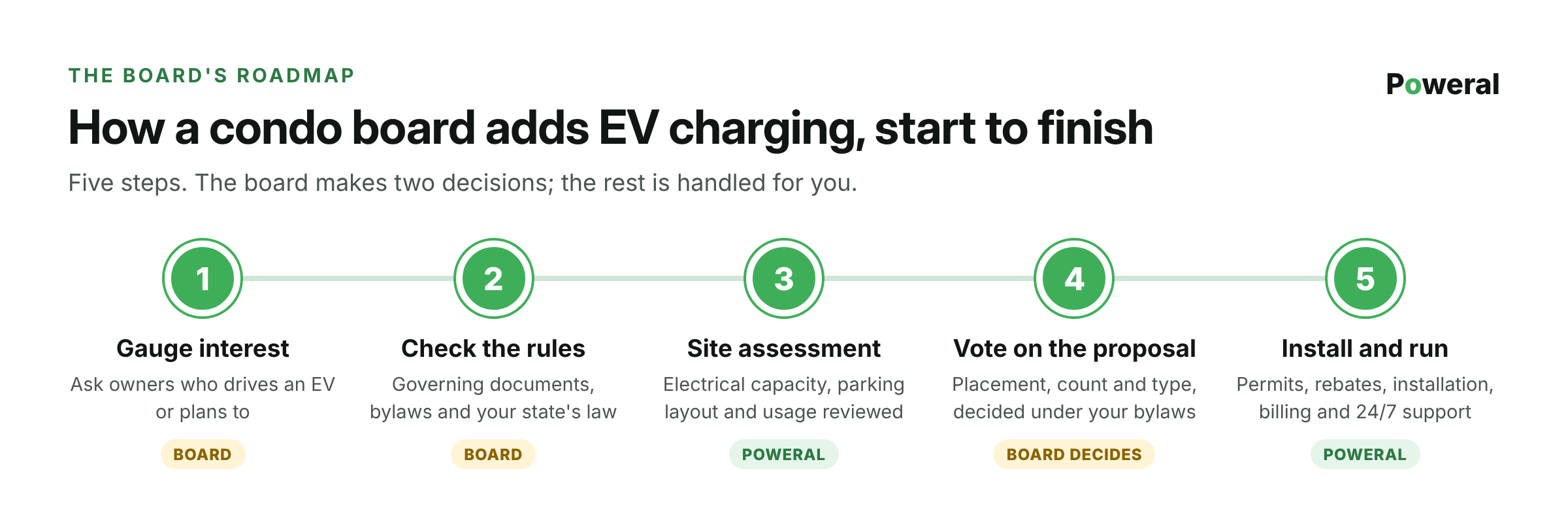
Ask owners who drives an EV now or plans to. A short survey gives the board a starting number of chargers.
2. Check the rules
Review your governing documents, bylaws and state law, including who may vote on common-area changes.
3. Site assessment
Poweral reviews your electrical capacity, parking layout and expected usage.
4. Vote on the proposal
You get a clear plan for charger placement, count and type before anything is scheduled. The board decides under its bylaws.
5. Install and run
Poweral handles permits, rebates and installation through licensed electrical contractors, then billing, monitoring, repairs and a 24/7 driver support line.
See how the process works, or look at communities we have completed.
5 objections condo boards raise, and the answers
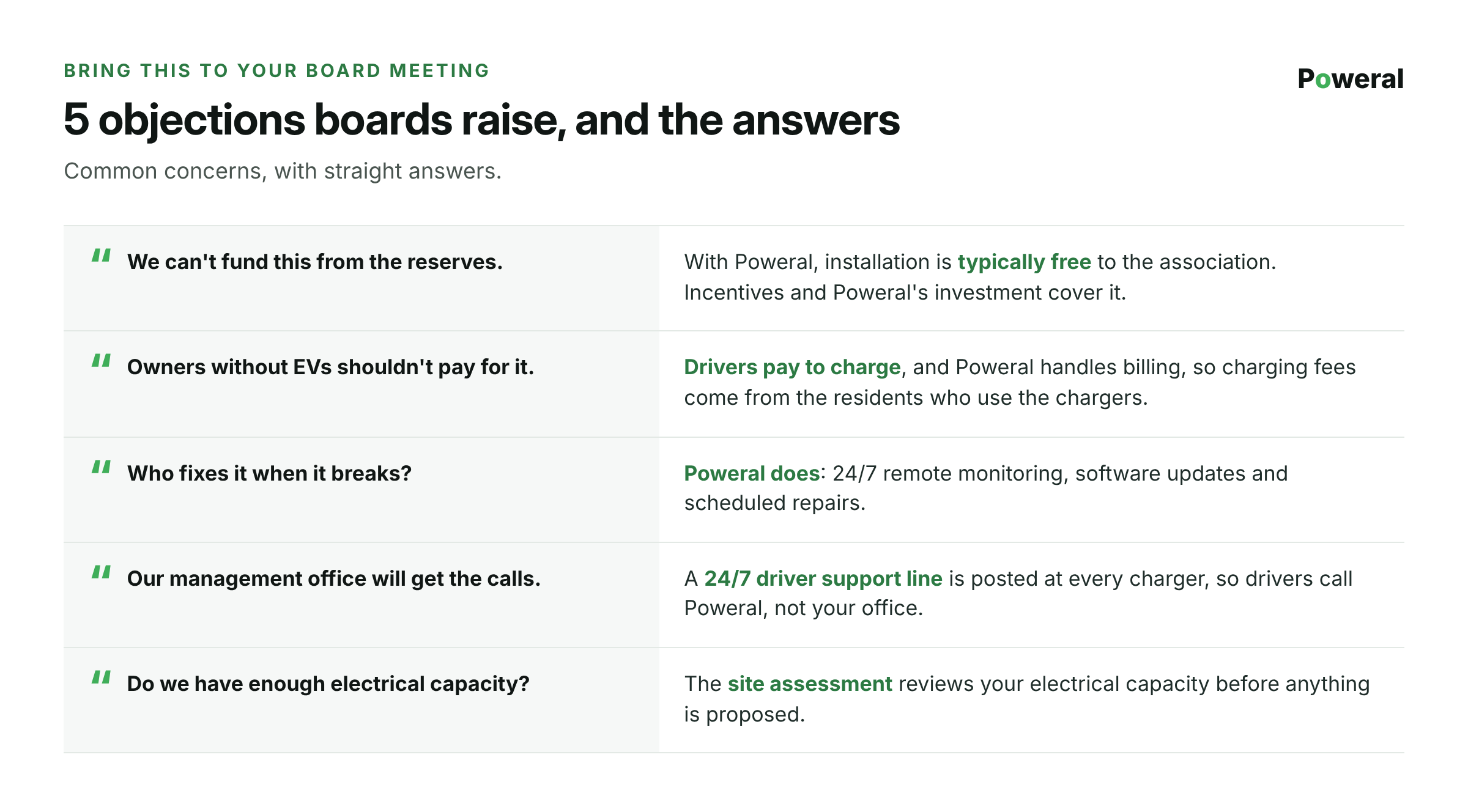
“We can’t fund this from the reserves.”
With Poweral, installation is typically free to the association. Incentives and Poweral’s investment cover it.
“Owners without EVs shouldn’t pay for it.”
Drivers pay to charge, and Poweral handles billing, so charging fees come from the residents who use the chargers.
“Who fixes it when it breaks?”
Poweral does, with 24/7 remote monitoring, software updates and scheduled repairs.
“Our management office will get the calls.”
A 24/7 driver support line is posted at every charger, so drivers call Poweral, not your office.
“Do we have enough electrical capacity?”
The site assessment reviews your electrical capacity before anything is proposed.
Before signing with any provider, bring our 10 questions to ask any provider to the meeting.
Which chargers work best for condos?
Level 2 chargers are the standard choice. According to the U.S. Department of Energy, they add about 25 miles of range per hour, enough for residents who park overnight. Poweral installs the Tesla Universal Wall Connector, which charges Tesla and non-Tesla EVs, and the Autel MaxiCharger A12, available with a J1772 or NACS connector. See our EV charging installation service.
Already have chargers that are outdated or broken? See our Charger Replacement Program.
Frequently asked questions
Can I install an EV charger at my condo?
Usually, with board approval. In New Jersey, the association can’t prohibit or unreasonably restrict a charger in your designated space, but it can require approval, a licensed electrician, insurance and that you pay the costs. In Pennsylvania, Delaware and Rhode Island, your board’s rules decide.
Can an HOA deny an EV charger request in New Jersey?
Only for limited reasons, such as a reasonable life-safety concern. If the association doesn’t deny an application in writing within 60 days, it is approved under P.L. 2020, c.108.
Who pays for EV chargers in a condo?
For an individual charger, usually the requesting owner. For shared chargers through Poweral, installation is typically free to the association, and drivers pay to charge.
How much does it cost a condo association to install EV chargers?
With Poweral, installation is typically free to the association, covered by incentives and Poweral’s investment. Costs depend on your site, so Poweral confirms them after a site assessment.
Who maintains shared EV chargers in a condo?
With Poweral, Poweral does: 24/7 remote monitoring, software updates, scheduled repairs and a 24/7 driver support line.
How do you charge a Tesla if you live in a condo?
At a Level 2 charger in your building’s shared or assigned parking. The Tesla Universal Wall Connector, which Poweral installs, charges Tesla and non-Tesla EVs.
Does Pennsylvania have a right-to-charge law for condos?
Not yet. Senate Bill 561 would address EV charging in condos, co-ops and planned communities, but it has not passed.
What should a condo board do first?
Gauge owner interest, check your governing documents and state law, then get a site assessment so the board can vote on a real proposal.
See what your community qualifies for
Tell us about your community and we’ll check which incentives apply. We reply within one business day. Property managers: forward this guide to your board before the next meeting.